Tag Archives: Violence against women

Is Violence the Answer?

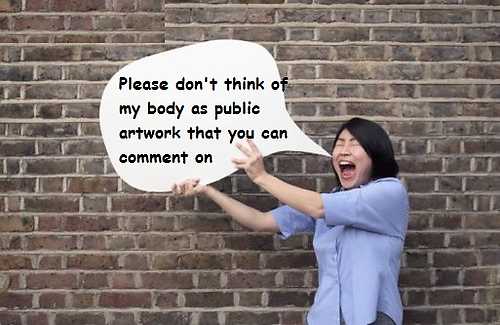
public artwork

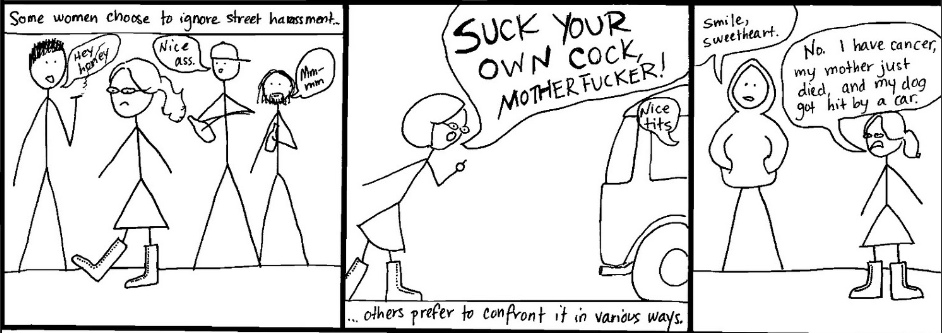
I am so sick and tired of being treated like public property by men who feel entitled to my body when I leave my house. I wish my first post during Women’s History Month was more uplifting but I really have to ask, and I wish my feminist foremothers were here to give me an answer: What do you do when you are publicly harassed/groped/sexually assaulted?

street-harassment-comic


Obviously this post is the result of a personal issue but of course the personal is political so my story is that of countless billions of other women in the world too. Just today a black woman of roughly my age, waiting for the same bus as me, was being “talked up” by a mid-50s white guy. She clearly wasn’t interested and yet he kept talking at her. I nearly interjected, “Bro, she doesn’t want to talk to  you.” But by persistently ignoring him she eventually shut him up. I know she wasn’t interested by the look on her face, and because I know exactly how she felt because not 15 minutes earlier at the same stop another old white guy came up to me.

“Can I ask you a question?EndingStreetHarassment
“Mmhmm.” (Hoping it would be about what number bus, etc.)
“Why is your hair so much better than mine? (He was bald)
“Genes.” (And a fake, fuck off smile)
“Hahaha, exactly. You are beautiful.”

Fuck man, seriously?!? I can’t just wait for the fucking bus without you feeling like you have to tell me that I live up to your socially constructed beauty standards? And I’m sick, not wearing make up, covered from head to toe because I’m cold and wearing sunglasses and headphones. How much clearer could, “Don’t talk to me” get? It shouldn’t surprise me though because yesterday a young white guy started talking at me as he approached the bus stop where I was sitting and did the same thing. I had headphones on (my normal defense mechanism against misogyny and douchbaggery) so I didn’t hear the first part of his ode, but once he was close enough I heard “You’re absolutely gorgeous.” And then he disappeared around the corner. What the fuck was the point of that!?!?

jess_fink_comic.JPG1_

If you’re going to compliment someone, wait until you get their attention, if they don’t seem utterly annoyed that you’ve pulled them away from their music/book/laptop/phone, proceed with your compliment, then wait for an appropriate response.

You may be thinking, what’s the big deal, guys think you’re pretty, it’s a compliment, just be thankful. I refuse to be thankful that my body is not considered my own, and that simply because I am a woman I am subject to harassment when I enter public space. The very same thought process that says, be thankful, is the one that condones and promotes rape culture and victim blaming, after all, women want it, right?
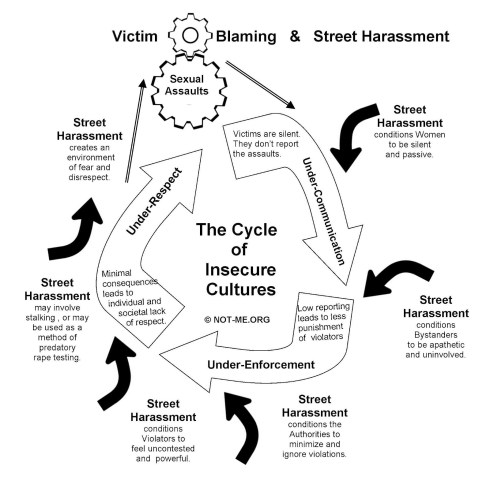
Cycle of Insecure Cultures

Here’s the example that prompted today’s blog of fury. I was sitting on a crowded bus with my bag in the window seat next to me. A young black man comes up and says something while pointing at the seat. Headphones on I have no idea what he said but I grab my bag and get up so he can sit. Once he sits he spreads his legs so that he’s taking up half my seat and is holding onto the outside of his pocket so that he brushes my thigh until I scoot so far over that half of my ass is off my seat. He tries to talk to me, I pretend I can’t hear him, use my phone and silently beg the universe to let another seat open so I can get away from him. He pulls something out of his pocket and taps me with it. I take out my left headphone to hear him offer my what appears to be grape-flavored lip gloss. I say, “No. Thanks,”  and put my headphone back in. Finally the universe listens and a bunch of people get off the bus.
deal with it

I move over into the same row on the other side of the aisle, with my bag again in the window seat. He is staring at me, and with Austin traffic for the kite festival he has all the time in the world. I make it a point to look out the window on my side, trying desperately not to look at him, engage him or let him know how uncomfortable I am. Out of the corner of my eye I’m fairly sure he’s masturbating but I don’t dare look. The rage and sadness and fear that I felt meant that if I had seen him my reaction would have been violent, and I try so hard to practice peace in my personal life. Once the frantic movement across the aisle stopped I quickly glanced his direction only to see him flash open his jacket. Luckily I was just glancing or I probably would have seen more than I should have.

By this time nearly everyone else has gotten off the bus and since it was on detour I feared my stop was coming up soon. I was genuinely afraid he was going to follow me off the bus, so I went to the bus driver and asked her if the detour would indeed go where I needed to. She said it would but it would be another 45 minutes. Then I told her I thought the guy was masturbating and her face was a mix of anger, sadness and understanding. “I’m so sorry honey,” she said. “Who is it?” I clarified and when he didn’t get off at the next stop she called back to him, “Are you ok?” He responded and then got off at the next stop. She asked, “Was that the one?” and I confirmed it and she apologized again. After that it was a long but uneventful ride.

street-harassment

My question to you–and please give me answers–is this: What is the appropriate response when a stranger stares at you? Circles the block to look you up and down as you wait for the bus? Tells you you’re beautiful or you’re working your boots or there’s a party you should come to or you’re got a slammin’ ass or vulgarly suggests you do something sexual to him? What is the appropriate response when a stranger touches you? When he jacks off at you?

Because in those moments, violence is the only response I have been able to fantasize, so instead I just ignore them and let a piece of my soul die.
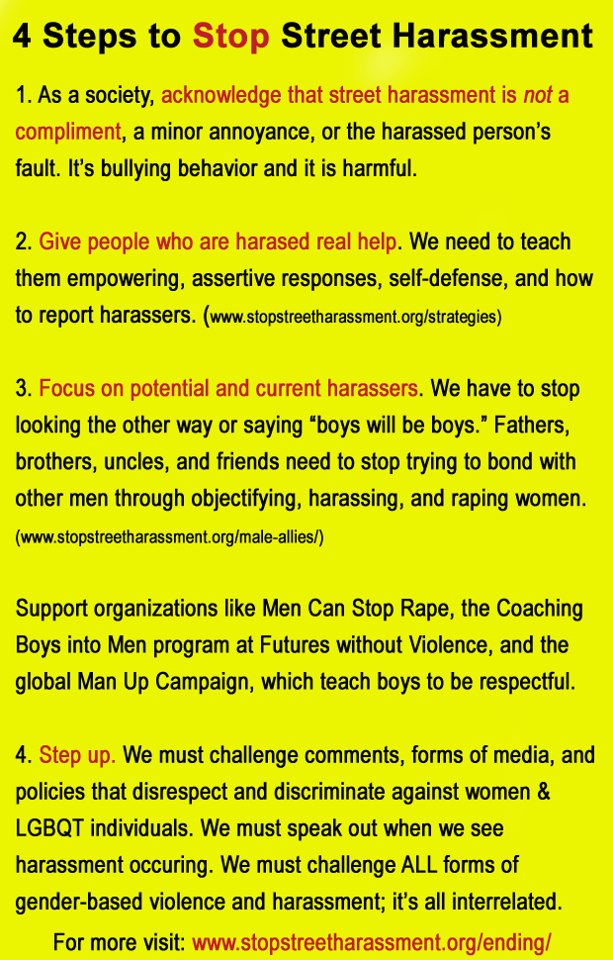
 

stop street harassment

hhhhsss


What I Learned From DFA


I recently finished Democracy for America‘s online activist training “The War For Women” in the hopes of combatting current Republican efforts to undermine women’s rights in the United States. To see the series of events that set off the need for this training watch this depressing video and refer back to this blog. Even Al Jazeera is exploring America’s feverishly religious abortion debates. The training was entirely virtual (and entirely FREE–thanks DFA!) and took place once a week for an hour; because of the time difference this meant I tuned in from 3-4AM to participate but, as any good student will tell you, sleep deprivation is a small price to pay for knowledge. This highly interactive War For Women training consisted of six topics, each featuring experts in their respective fields and downloadable action kits full of ideas, links and practical information for activists wanting to get their hands dirty in the fight for justice. What follows is my take on each session.

1) Heath and Reproductive Rights
Inhabiting the same (albeit virtual) space as Cecile Richards (President of Planned Parenthood) was a little overwhelming. Her fervor and success in fighting for women’s sexual and reproductive health and rights is inspiring. The furor with which the religious right-wing is attacking women’s sexuality and bodily autonomy is terrifying, maddening and outrageous. Check out this timeline of reproductive justice that takes us up to October 2011 before the onslaught of War on Women legislation this year. Because of my extensive background in SRHR much of the factual information presented I was already familiar with, but the action ideas for fundraising house parties and creating more community dialogue and support for Reproductive Justice will be useful for even the most seasoned activist. Check out this session’s action kit here. Its 14 pages are full of useful ways to make sure women’s reproductive health and rights are not diminished by the government. Other downloadable tools for this topic include a Planned Parenthood Action Fund Toolkit, a WAW Volunteer Sign-up Sheet, an Obama/Romney Contrast graphic, and a WAW Pledge Card.

2) Victory Over Violence
Violence against women was one of the first topics as a young woman that enraged me, and consequently pushed me into feminism and activism. The highly successful and extremely established presenters of this session (Debbie Tucker, the Executive Director of The National Center on Domestic and Sexual Violence and  Susan Celia Swan, the Executive Director of V-Day) likewise have devoted their lives to combating gender based violence in the US and around the world. A considerable portion of the presentation is devoted to getting trainees up to speed on the sickening recent delays in passing the Violence Against Women Act. The hands-on training is facilitated by Ruby Reid, DFA’s spectacular Online Training Organizer who also emcees the other five sessions. Reid takes activists, step-by-step, through the proper etiquette for successful lobbying of elected officials. Lobbying should always be the first action those wanting to make change take; when lobbying fails, however, there are a host of strategic nonviolent actions to fall back on. Reid and Tucker share best practices for contacting supportive/undecided/non-supportive legislators, a great To Do/Not To Do list for lobbying, and tips on organizing a successful (and media flooded) rally. There are useful tips in the training for men who want to take action against violence against women too! The Victory Over Violence action kit can be found here.

3) The Economic Gender Gap
The feminization of poverty happens all around the world and in the United States the issue of equal work for equal pay is somehow still contentious. Host of The War Room, former Governor of Michigan Jennifer Granholm ties the whole War For Women together in a four-and-a-half minute video explaining how the underrepresentation of women in politics and science, and how injustice in reproductive health all affect women’s earning power and thus the economy of the United States. Shockingly, if all women in the US were paid equally it would add $523,900,000,000 to the consumer economy!  This session gives lots of other surprising and outrageous information about how unequal pay affects women’s lives, but the focus of the action-training is on branding. The “friendraiser” Jennifer Daniels, an expert in messaging, takes us through how to craft an effective narrative that addresses issues that affect you. The detailed and useful information here builds on the lobbying training from the second session and comes into play again in the fourth session. Here is the 13-page action kit for the Economic Gender Gap which includes an extremely useful tool for any strategic nonviolent activist: Creating a message that resonates.

4) Women and the Media
Used in conjunction with previous subjects like how to craft an effective narrative and how to be successful in lobbying (and because of the overwhelming importance of media coverage and access and how few women are represented in the decision-making processes of media,) this training may be the most important. The trailer for the 2011 documentary Miss Representation opens this session and a short analysis of how representations of women in the media affect everyone’s ideas of what women can and should be follows. MSNBC Analyst Karen Finney leads a discussion of how women can be seen as authority figures and effective leaders in the media across the spectrum of topics. She also addresses the fact that a woman has not anchored a presidential debate in the past 20 years. Since the training took place it was announced that CNN anchor Candy Crowley will moderate a town hall-style debate. Kimberly “Dr. Goddess” Ellis addresses what she learned from  the Geena Davis Institute on Gender in Media and the unequal and sexist coverage of the Olympics in the US. Her major point is that we must support women in media by watching women, supporting/funding women who are trying to make their way into the media and not tokenizing women or people of color. John Brougher, Founder of the blog Male Feminists, addresses how women’s allies can use their personal and political power to work for women’s progress. DFA’s Communications Director, Linsey Pecikonis, leads the training in earned media, explaining the differences between (and how to use) press releases and news advisories and how to make pitch calls to media outlets. The action kit for Women and the Media, including templates for news advisories and media kits, is available for download here.

5) Women as Voters
Celinda Lake, President of Lake Research Partners and prominent strategist and pollster, uses research to oust incumbent Republicans from office. Her video highlights what issues have historically been important for women voters, how disparities in voting affect women and how to get women back to the polls. The NAACP National Training Director, Jessica Pierce, tackles the intersectionality of oppression and how voting affects issues that are critical to women, people of color, the working class, etc. She also addresses recent voter suppression efforts and how the NAACP is using all kinds of media and outreach to get more people to vote all over the country. The activist training portion of this session, lead by Ruby Reid, covers tried-and-true get out the vote “GOTV” tactics that work for women. Women as Voters action kit includes great tips on how to register voters and how to identify supporters and contact voters. The National Mail Voter Registration Form (which can be used in every state except New Hampshire and Wyoming) is also there for download.

6) Women as Candidates
With women representing an abysmal 17% of Congress, the importance of women running for office could not be clearer. Check out Emily’s List‘s Impact Project to see how important it is to have women in office. Jennifer Granholm is back in this session to share her experience as a candidate and encourage us to build bridges between women in office and those women who are considering running. The 2012 Project, with its tagline “Don’t get mad. Get elected.” is working “to increase the number of women in Congress and state legislatures by taking advantage of the once-in-a-decade opportunities of 2012.” Debra Shore, of the Illinois Water Reclamation District, takes us through practical aspects of running for office for the first time including crafting your narrative, the importance of fundraising, the impact of running on personal relationships and finding support in unlikely places. Angela Zimmann, a candidate for Ohio’s 5th Congressional District, shares her experiences as a candidate and how to overcome dismissive detractors and feelings of inadequacy. Erin Molchany, Candidate for State Representative in Pennsylvania’s 22nd District, explains what made her campaign successful: hard work, inclusivity and accessibility to voters.  Regina Schwartz, Deputy Director of the Analyst Institute, shares her very interesting work in understanding how voter outreach affects elections, how to make campaigns as effective as possible and more successful GOTV tactics.

Overall these six sessions were very enlightening and worthwhile. Take six hours of your life and watch each webinar video, then take another three and go through each of the action kits to make yourself the most effective activist possible in the War For Women. If you’d like to participate in any of the upcoming virtual or local DFA trainings, contact them here. To contribute to their very important work and make trainings like these more accessible for everyone, go here. Thanks for reading, now go out and change the world!


Misogyny and Masculinity in the US Military by Jacob Steele

Don’t Ask, Don’t Tell has been repealed. So we are now allowed to be as misogynist and violent as they are. Well, good job. We can now hate women and outside cultures as good as the next man. Just don’t call me “fag,” or I’ll kick your fuckin’ ass.

We’re now allowed to serve the military machine, the clearest and finest example of patriarchy our country has to offer. Is this really a step forward? African-American men were allowed to serve in all specializations some time ago. Women of all races could serve fully in 1981 (just not in combat, because women can’t kick ass or take names like a man can). And now women and men of whatever sexual orientation, in 2011. Have those oppressed groups that went before us, integrating into the military, changed the institution from the inside? Have they made it a less oppressive, less violent expression of the hegemonic masculinity? Or have those souls who have already been admitted only been subverted into that masculinity themselves?

Fully a third of military women will be sexually assaulted or raped during their time on active duty. Of those, a mere 8% of their assailants will be brought up on charges, and basically none of those that are actually charged will be convicted or face penalties stronger than a short-term pay cut. And this is how we treat our own soldiers! Imagine what happens to those that are labeled “enemy.”

But this is the institution that we can now serve, outly and proudly. As this bill—the culmination of years, even lifetimes of work on the parts of many of us—goes into effect, it’s past time to think about what we’re asking for when we ask to be part of the old boys’ club. What exactly will membership get us? And what, precisely, is the price of that membership card?

The answer already seems clear. From the personage of Lt. Dan Choi, who was the de facto figurehead of the movement until the bill was passed earlier this year, to the ongoing efforts of Human Rights Campaign (HRC), the main thrust of the movement has been to prove that gay men and lesbians are just as good, just as hard, just as military, as their heterosexual counterparts. Lt. Choi, for example, once challenged a friend of mine to a push-up contest at a speaking event—but the self-styled leaders of our movement lack a critical lens at much deeper levels than this sort of machista bravado.

The masculinity that dominates the military and seeps into every aspect of our culture is itself pathological and destructive. This is borne out statistically, as above, and anecdotally, by thousands of stories of men soldiers’ violence against their wives and girlfriends, against women soldiers, and against other men. By pushing so hard to have the same rights that those straight white men take for granted, we have underplayed our hand. The question has not been and should not be “How can we get the same rights as them?” but “How did they ever get the right to rape, to batter, to destroy?”

Hopefully, the LGBTQ movement entering openly into the military will shed light on the fact that, right now, military men (and many non-military men) have those rights—rights which no one should ever have or want. Hopefully, our serving in the military will change the masculinity displayed by so many military men into one that is less violent, less misogynistic and (more obviously) less homophobic.

I fear, however, that our military service will only make those that are serving more violent, while the institutions we serve gain an air of “tolerance” and openness. I fear that gay men and lesbians will come to be seen as “normal” not because of an embracement of diverse sexuality in the public sphere, but because gay men and lesbians serving in the military will become closer to the norm—that is, violent and misogynistic. It’s up to us to not let the repeal of Don’t Ask/Don’t Tell (and, soon, Defense of Marriage Act) be the end.

It’s up to us to keep living and discovering and activisting a new masculinity, to keep calling out, in the streets and in the courts and in our homes, the pathology of the dominant masculinity. And it’s up to us to explore, become, and teach ways of being men that exclude violence as a legitimate way of interacting with our world in the day-to-day, and certainly, at the least, exclude perpetrating sexual violence in any of its myriad forms. It’s up to us.

Jacob discussing life with una vieja in a 'retirement home' in Nicaragua as a member of the NGO Project HOPE, where he a group of sailors from the hospital ship USNS Comfort and other civilians were doing maintenance to the infrastructure of the retirement home

Jacob Steele is a former Navy Officer and veteran of Operation Enduring Freedom. He holds a Master’s degree in Media, Peace and Conflict studies from University for Peace, Costa Rica, and is currently rediscovering his native United States by motorcycle, bus, and car. He is 29.


Man Up! by Göktuğ Salgırtay

Man Up!

Be a man.

That’s not manly.

Are you man enough?

I want a real man.

We often hear these phrases when a male person’s manliness is explored. What is really in question here though? Is it his economic status? The size of his penis? His physical strength? His courage? His supposed lack of emotions? Whatever it may be, there are many misconceptions about masculinity. A “real” man is mostly described as fearless and tearless, a warrior.

Yes, it is a fact that most of the world’s soldiers are men. Military training, boys’ peer groups and media often promote a direct link between being a “real” man and the practice of dominance and violence. It is true that men are responsible for most violent crimes, largely due to the fact that men rather than women are central to the symbolism of violence in mass media, sports and political rhetoric.

It is clear, there are links between masculinity and violence. To recognize this is not to say that all men are violent, or that men are naturally violent – it is to discover masculinity and its effects on gender-based violence.

Pointing out issues about masculinity can be misunderstood. It may be seen as unfairly blaming men for all violence, or implying that women are inherently better people. On the contrary, it may be seen as a way of excusing violent men, since the behavior is attributed to masculinity, which many believe to be natural and unchangeable. The focus, however, should be on characteristics of socially constructed masculinity that lead men towards violence, and on the ideologies that reinforce aggressive behavior. This allows the focus to shift towards prevention of violence against women and the building of positive alternatives.

Violence against women is used as a “policing mechanism” to emphasize socially set gender roles, and to perpetuate gender-based inequality. There are structural and personal roots to gender-based violence. At the structural level it is grounded in Patriarchy; a system that positions men over women (and other men). At the personal level it is also based on pressures, fears and emotions that underlie many of the dominant forms of manhood adopted in different settings.

The biology of sex does not explain the issues; biological differences are just that, while social patters of violence require social explanations and solutions. Our understanding of masculinity must embrace economic production, power and authority, sexuality and emotions, and identities and communication. Eliminating violence against women and building a culture of peace requires change in masculinities. But it does not require men to be weak or incapable. On the contrary, violence often occurs because masculinity is constructed to make violence the easy option, or the only option considered. We must move towards a leadership that does not see violence as the only alternative. The leadership “inherent” to masculinity should be used to work towards gender equality rather than to further segregate the gender hierarchy.

Education can open up a diversity of pathways, and allow boys and men to use a broader spectrum of their capacities; emotional, communicative, and political. Education can show boys and men a variety of ways of being a man, and allow them to experience this diversity. It can develop boys’ and men’s capacities for nonviolent action, training them in techniques of peace as they are now commonly trained in the techniques of combat.

An educational effort in this direction cannot work in isolation. It needs to be supported by action in other areas of life that will make greater diversity of experience possible for men, and nonviolent conduct easier for them. This means action to reduce gender hierarchies across the spectrum of social life, media, workplaces, and institutions.

Moving towards gender equality is an important part of the culture of peace as well. Cooperation and dialogue between women and men create new knowledge and positive change. Men’s groups should not pander to those who might attempt to emasculate them for fighting for gender equality. Media constantly emphasizes the “natural differences” between men and women. The fact is what men share with women – talents, languages, interests, institutions, and family – is far more than what divides them. As long as we focus on the mutual benefits and share the responsibilities, we will have the basis for a non-violent future.


Göktuğ was born and raised in Istanbul. He moved to the US during high school and was lucky enough to live in many awesome cities while earning his degree in gastronomy. Thirteen years later he’s back, living in southern Turkey near his family. He and Feminist Activist are currently living and loving on the beautiful Mediterranean Sea. He is very proud of his partner’s work towards gender equality.  


Hijacking the Political Gender Discourse by Sven Schulte

Sven celebrating the success of UPMUNC 2010

The following article aims to shed light on the forms of structural violence against women within the realm of German right-wing extremism and how this is reflected in the political program of one party with the result of them hijacking the political gender discourse.

When considering female participation within the largest German right party NPD, Peter Marx accounts that the party currently prides itself with 27%, which is inter pares to the percentage in other parties. Moreover, around half of new members are girls and women, indicating the demographic change within right-wing parties.

Consequentially, more topics related to the gender discourse, such as day care centres, leave of absence for childbirth, child support etc. have permeated the rigid, male-dominated discourse of right-wing politics.

Yet the logical deduction that a higher percentage of women translated into inclusion of affiliated topics into the political discourse is a fallacy.

Rather, right-wing parties are more successful in capitalising on such themes in order to lure female support.

It is a twisted plot of male structural violence against women to ensnare them into bastardising their own cause.

That is because the underlying reasons for these political campaigns are not to advance the status of women or to contribute to equality.

Gitta Schuessler , President of the RNF (Ring of National Women) accounts that gender mainstreaming is first of all unnecessary, because in essence “all equal rights are fulfilled”, citing the right to vote, education and choice of profession.

That there are severe inequalities of payment between male and female in Germany or women significantly underrepresented in key positions in industry and science are negligible impurities in her view that are no cause for concern.

Moreover Schuessler identifies gender mainstreaming as an undesirable “re-educational project which wants to reshape innate gender identities”. This anachronistic image of distinctively separated gender identities is in turn based on nationalistic credo seeing women as mere birth-givers, rather than emancipated women.

That is because the path to female self-actualisation is becoming de-individualised and embedded in right-wing ideology.

It is postulated that true female happiness can only be achieved by producing offspring and caring about family, instead of individual pursuit of strengths to form careers of their own.

Henceforth, the political gender discourse becomes hijacked, as the underlying reason of equality becomes substituted by a bastardised right-wing dogma about female rights and responsibilities.

Yet the message that is transcended to the people is “We care about women and children” which in turn lures women and girls to support such right-wing extremist parties, recalling that half of new members of Germany’s extremist NPD party are girls and women. It is a dangerous vicious circle.

The real treason to the emancipatory cause of it is barely detected by the gullible souls that are preyed upon by the male perpetrators of structural violence and their female henchmen that steal and bastardise the political gender discourse in order to sway more women into mindless devotion to renounce themselves.

Sven left Germany at the age of 16 to study at an International School before embarking on studying International Relations and Peace & Conflict Studies in London, UK. He currently holds one MA in Environmental Security and Peace (UN-mandated University for Peace) and is a candidate for an MA in Peace, Development, Security and International Conflict Transformation. Scientifically questioning power structures and structural suppression, his methodology is influenced by the multitude of nuanced analysis that the gender paradigm offers.


Carolina’s Story by Anonymous

Place a piece of paper on your head.  On the paper, without looking, draw a picture of a girl.  Start with the head, the hair, then the features on the face, eyes, nose, ears and mouth, then the torso, the arms and hands, the legs and feet, and finally the genitals.   Do not look at the picture until you have reached the end of this piece. 

…………..

Carolina is 15 years old, and from one of the poorest neighbourhood’s in Nicaragua’s capital, Managua.  She has to look after her two younger brothers, both of which come from different fathers.  She herself has a one-year-old son.  When she was 13 years old she was raped by her stepfather and uncle, after the two of them had come from a late-night drinking session.

The dysfunctional nature of her family meant going to college to get an education was never an option.  Since she was 9 years old she was forced out onto the dangerous streets of Managua, to sell cigarettes and chewing gum at one of the many party and bar zones in the city.

One night, another gruelling night of selling cigarettes to the drunks at 2am, a man, a foreigner, came and spoke to her.  He was drunk, and smelt heavily of beer and smoke, but he wanted to spend the night with her.   He said he would give her $20 if she agreed.  Carolina disagreed, the man was revolting.  When she did so, the man smacked her, around the face.  It was in full view of everybody, but nobody really seemed to take notice.   She eventually agreed, and went with the man to one of Managua’s many motels.  The man forced himself onto her, breathing heavily as he penetrated her.  The pain for Carolina didn’t seem to last too long, somehow her body went numb, she fell into a form of daze, no longer really aware of what was happening around her.

Two nights later the same man spotted Carolina at her usual spot by the bars.  As he spoke to her in his broken Spanish, Carolina took in little of what was being said, focusing only a few words, Costa Rica, new life, good employment.    Defences had been broken.  The following day the man went with Carolina to her home.  Her stepfather hurriedly signed the permission slip for this man to take her to Costa Rica, only too happy to get the unhappy girl that he had raped out of his home.  Carolina’s mother seemed far less sure about the decision, and very suspicious about the employment.  A few slaps to the face from Carolina’s stepfather however quickly made her change her mind.

In a remarkable short space of time all documents were signed, and Carolina found herself on the bus to Costa Rica.  She had never left Nicaragua before, and was nervous, but excited about what awaited her.  Nine hours went by, the journey was quite slow as for some reason they had been held up at the border, but they finally arrived at San Jose.  It was about 8pm.   The man had told her he would take her to her new home.  This new home was on a dirty but busy street. They entered through the side door, it was locked behind her.   She stepped on a used condom.  She saw dozens of girls, all of them in mini-skirts and high heels.  None of them looked any older than her.  None of them looked her in the eyes.  Things were feeling very strange.  Two men approached her.  One of them grabbed her by the hands, the other she saw lowering his pants.  She went numb again.

15 months later and Carolina is now back in Nicaragua.  In total she worked at 6 different bars in San Jose, where she was abused, beaten up, raped and exploited sexually for commercial purposes on a nightly basis.  She is now being cared for at the Casa Alianza protection centers in Nicaragua.

Her story is devastatingly common.  Girls coming from impoverished backgrounds in extremely macho cultures, themselves victims of violence and abuse, finding themselves forced into sexual abuse and exploitation with little or no chance of escape.  They are broken down physically and psychology.

Carolina’s story is not real.  There is no Carolina, but after having spent nearly three years living in Central America, in which I have spent over half that time working for Casa Alianza, an NGO working to protect children in extraordinary risk, her story is all too real.

The reality is great, and there are steps which must be taken by us all to prevent children, women and girls facing such extraordinarily difficult situations:

  1. We must provide training to families to care properly for their children, especially female children
  2. We must provide awareness about domestic violence, and the support for women who are the victims such crimes
  3. We must tackle macho cultures which enable and accept violence and other crimes against women and girls
  4. We must provide the care and support for the women and girls who have been victims of crimes such as this, providing the psychological and physical care needed
  5. We must never tolerate any form of violence against women and girls.

And now, let’s go back to your drawing.  I am sure the image you have constructed is not a beautiful piece of art.  I am sure, in fact, that it is a very mutilated image.   And so why did I ask you to do this?  Because this mutilated image shows the destruction done, both on the inside and the outside, to the girls and women who are the victims of abuse, violence, sexual exploitation and human trafficking.    

We must unite to provide the training and awareness to prevent violence against women.

The author was born in the UK, although he has been fortunate to spend large parts of his life in different countries, working as an English teacher, radio presenter, trainer of debating and public speaking, and coordinator of Model United Nations events.


Violence Against Women in Iran by an Anonymous Man in Tehran

Haleh Sahabi, a human rights activist killed at her father's funeral

Many people in Iran have not heard or read anything about violence against women in the mass media. Actually they are faced with many economic and political problems that don’t let them spend time and energy on subjects like VAW. In my opinion the items below could be considered VAW cases or related items in my society:

1. Police forces are not devoted to handling situations of physical and sexual violence against women. They don’t have enough expertise, ability, education, skills or organization budgets to face these kinds of crimes. The priority to spend budgets belongs to political and military issues, directly or indirectly.

2. A lack of freedom of expression in mass media: radical political and religious filters (especially after the election 3 years ago) tend to prevent any news or report that challenges the government performance nationally or internationally, and suppress any internal media activity which crosses their power boundaries severely. This means that they prefer not to follow up on violence against women in the media, instead of asking questions and thinking about it like other social issues.

3. An undeveloped judicial system: many VAW cases in Iran happen in the family and home environment and are not considered as criminal activity which should be tracked in court. The judicial system cannot respond to women’s needs and create judicial support for them because of the unwillingness and inability to approve any rule from outside of Islamic rules. Below is the part of chapter 34 of the Holy Koran, the name is Alnesa (which means women) in Arabic :

وَ اللاَّتِی تَخَافُونَ نُشُوزَهُنَّ فَعِظُوهُنَّ وَاهْجُرُوهُنَّ فِی الْمَضَاجِعِ وَاضْرِبُوهُنَّ فَإِنْ أَطَعْنَکُمْ فَلاَ تَبْغُواْ عَلَیْهِنَّ سَبِیلاً إِنَّ اللّهَ کَانَ عَلِیًّا کَبِیرًا

This chapter is about how men can punish their wife, and one of those ways is “beating them.” With attention to this obvious Holy Koran chapter any Muslim could beat his wife and the judicial system and police forces can’t stop him easily. Fundamentally, there is no equity in responsibilities and rights between the male and female sexes in Islamic rules.

4. Recently the government decided to separate boys’ and girls’ classes in all universities instead of solving the numerous problems of the country’s educational system. This action will lead to less understanding and fewer transactions between the two different sexes and may increase conflict and violence more than before in their lives after university.

5. There are few supportive systems or institutions for minority groups who need to be cared for. They don’t work well or in line with their mission statements. While there are groups for women who were raped or abused, or people with disabilities, and even people who lost their health or organs through the 8 years of imposed war between Iran and Iraq, overall these institutions do not take responsibility to use their budgets to help.

I would like to mention that the level of security, social services and economic welfare in Tehran, the capital, is much more than any other city in Iran and only 11 percent of Iran’s population lives here. Our system is based on centralization and so other cities are less developed in many aspects, considerably in considering social issues like VAW.

P.G. 
Bachelor of Public Administration, Allameh Tabataba’ee University, 2007
Master of Management, University of Tehran, 2009

To read this post in the original Farsi come back tomorrow!


You Don’t Hit Girls! by Robby Ally

First of all I would like to thank my teachers for cultivating a person that somebody as active in the equality movement as Feminist Activist would consider a feminist. Even when I write the word now, feminist, in relation to myself, I laugh out loud. Thank you for the opportunity to have so much fun wading through my dream of memories and try and add a bit of value to your meaningful work. Before it’s too late I would like to dedicate this to all the men out there who cannot express themselves and to all the women who are confused by their own physiology.


“YOU DON’T HIT GIRLS!!!”

That was what the girl next door’s father yelled at me as his carpenter’s hands wrathfully shook me by the shoulders with my feet dangling in the air. Before the shaking stopped, although I am not sure it has ever stopped, I suddenly thought to myself, “Why don’t you hit girls?” They are bigger, stronger, and certainly smarter than me. See, I had the grace to be the last one born to nice parents who already had two daughters. So in my little boy brain, girls were indeed bigger, stronger, and smarter than me.

Ok, so as not to bring the water to a boil as I dive into the deep end here, please allow me to state my intention on this piece. What I would like to share is that my intuition tells me latent violence on the intrapersonal level affects everyone on the interpersonal level in the form of overt violence. Through my experience this latent violence which crosses gender and cultural understanding seems to be realized by few and talked about by fewer though I suspect if affects just about all of us. I would like to draw off an example with a type of violence I can empathize for males revolving around an understanding of machismo. I would also like to bring up a type of a violence I cannot fully empathize with having to do with the whatnots of the female brain.

I remember a moonless night walking home from a wake when I was a fresh community organizer maybe a month into my job in rural Panama. The road was hard packed dirt slimed with mud and I was walking in the dark because the only person who had a flashlight was proving to me and his two sons that a man doesn’t need a light to make his way home…no matter how drunk he may be. That is why I thought to ask my dear friend, who is an even five feet tall with a body chiseled out of hard wood from throwing machete his whole life, what does machismo mean? He replied with one word as some roosters release a single crow during a cockfight, “Pride.”

A teacher of mine says that when the mind becomes full of pride, there will arise thoughts of competition and humiliation. As this pride becomes stronger and stronger, one will experience the suffering of quarrels and abuse. On the other hand, to my friend, pride was the highest expression a man could take. Machismo meant walking tall and being strong for the family at all costs. I can only speculate, but it may have been the internal struggle between competition and humiliation that this man’s pride cost him the companionship of his wife. My friend didn’t learn at the same age I did, you don’t hit girls.

To put my friend’s life into perspective, when he is at home, he is the “man of the house.” His dominance gets him the biggest portion of dinner and the only finger he lifts is to his mouth. But, when my friend is sweating for six dollars a day, he is humiliated by the man who owns the land. The landowner can do whatever he wants because he knows my friend has a crop of children back home with all their necessities and ambitions. It is a reality that my friend is not treated like a king when he is outside the home. When he returns home, his competitive attitude returns and to consider himself a man, he physically exerts his dominance over the humiliation that his six dollars a day isn’t enough to buy the opportunities for his children to break the cycle.

Furthermore, the violence doesn’t stop with the man. There are some instances that the latent violence extends from the women to the children. And from the children to the domesticated animals. To point out a sensitive subject, the children who are abusing animals may be abused in some form or another from the top down.

Without the slightest inclination to justify overt violence, I am inclined to understand my friend’s latent violence. A framework I can empathize with would be to imagine as vividly as possible what I would be going through if I were suffering the same affliction of pride given his conditions. As a man, I can ask myself how I would feel and how I would want my family to treat me. I can understand what a wounded man wants most. Sometimes, that is just a little bit of sympathy in the form of understanding that life is hard.

In an attempted to cross back over the picketed gender fence and provide an answer to the question, I aspire not to hit girls not just because I love them and want them to be happy; it is also because I simply do not understand them. My oversimplified understanding of women tells me that the female brain is flooded on a monthly basis with chemicals from birth until death. The precarious position I have found myself in over and over in this life suggests that some women do not understand their own physiological cycle. And for the sake of being polemical, I think that is a form of intrapersonal violence which can be seen in the form of interpersonal violence… having two brilliantly strong older sisters I can attest to that 🙂

So using the little empathy framework, my testosterone controlled brain’s solution is to be a provider. My goal is to provide space for women to grow into their inner beauty… usually by muting my words with a smile. And when I have the chance my satisfaction is to provide women with the opportunity to sleep for eight hours a day, eat three times a day, and stretch out in some fresh air. The only way to make this more complicated is to be in charge of providing ladies with their chemical fix by making strong coffee and finding delicious sugary treats. And people, I ain’t even getting into the utopian pleasure of random acts of kindness here!

That is all I got. It’s that simple. If I am a feminist, I am left wondering why on this tiny little planet it is all so complicated… oh I almost forgot my own pride.

Peace and love to all. May they find happiness and the causes of happiness and be free from the sorrow of suffering.


Currently Robby Alley can be found in the highlands of western Panama. He is working on an initiative to create legal and economic instruments to promote the sustainable use of biodiversity around a national park. Part of his passion is found while informally promoting the participation of rural community members in projects that create sustainable livelihoods through protecting nature. It’s been a struggle, but Robby has found happiness loving women and laughing with men.


Patriarchy and Misogyny in Politics Pave the Way for Violence Against Women by Fabrice Gernigon

I must admit that writing about gender issues is not the easiest task I have been given. And it is exactly because I don’t feel comfortable with that subject that I felt it would be interesting to dig a little deeper.

My feeling is that I am not the only one not to be at ease, because in France there is a huge gap between the progressive speeches politicians give to the media and the reality. The reality is that every three days a woman dies because she has been hit by her husband. This year more than 650,000 women reported that they had suffered from physical violences, and in their own home for half of them.

Despite the fact that this is a huge issue, I have to admit that I have never been directly exposed to it in my country. However I am convinced that even though violences against women are of course denounced by most men, they are deep-rooted in the customs of our society that is traditionally, and despite all appearances, still patriarchal and misogynist.

I think that the political arena is in a way a good caricature of our society. The French parliament, for example, is highly dominated by a male presence. Despite the fact that we had some very popular women in politics, most of the previous French Prime Ministers have installed women in their governments (as they had promised strict parity during their campaigns), to later replace them by men.

I am convinced that the lack of female representation in politics, or the difference of salaries between men and women who have the same level of experience and education, are facts that necessarily help maintaining, on one hand, the feeling that women are inferior, and on the other hand, that the place where they belong is at home!

A very interesting NGO (called La Barbe-which literally means The Beard but which is also a phrase that we sometimes say in France to say “That’s enough!”) pointed out that issue through their different actions. The women who work at that NGO went to high political or cultural institutions (such as the Parliament or the French Academy). Their actions consisted of breaking into these highly respected places, in silence, with fake beards. By doing that they pointed out the fact that there was almost no female presence in these institutions and their message was basically “Unless you are bearded there is almost no way you can have a place in these institutions.”

I am conscious that there is a difference between misogyny and physical violences against women. But what I want to point out is that misogyny often ends up justifying these violences.

A few months ago, the head of the International Monetary Fund, Dominique Strauss Kahn, (who was close to starting his campaign for the French presidential elections) was accused of the rape of a hotel maid in New York. There has been huge media coverage over this event in France since this man was seen, by most of us, as the next French president. Therefore, a lot of politicians and journalists started debating over what happened in room number 2806.

Despite the fact that nobody really knew what happened in that room, that “underground misogyny” suddenly came back up to the surface in the words of some politicians and journalists. Even though DSK was accused of rape, one of his political allies (Jack Lang) said that this man should be released because he had paid a large fine and because “He didn’t kill anybody.” It is a way of saying that rape is not a big deal after all, since nobody died.

A journalist called Jean-François Kahn said his impression was that there was no violent attempt to commit rape but that there was an “imprudent action.” He later specified by saying that DSK just lifted the skirt of a servant.

I think that through the DSK scandal, we have clearly witnessed that tendency to put rape into a favorable perspective. This is for me a sign that misogyny is not as innocent as we (men) want to think it is. And part of the solution to violence against women will come from getting rid of that very old-fashioned habit.

Fabrice Gernigon: I started my studies with a Bachelor of Arts in Information, Communication and Cultural Mediation. As I was interested in journalism, in 2007, I studied Political Sciences with a major in “Media, Society and Globalization” at the French Press Institute in Paris. Then I decided to focus my studies on the role of Media in conflict prevention and peace building at the University for Peace in Costa Rica. I later did an internship at the Head Office of UNESCO in Central America, with the Public Information Office. Back in France in 2011 I worked as a news coordinator for a French news channel called BFM TV.


Be “Good” to Women by DK

First and foremost, it is quite a saddening and somber fact that violence against women happens everyday, at an alarming rate. I was raised completely sheltered from this reality. I rarely saw it first hand and still to this day it seldomly occurs before me. Yet I know it is very real. My limited knowledge and experience on the problem narrows my scope on what common factors are linked to this. All I can say is that the lessons I learned from my mother engraved in my morals to be “good” to women.

The example my father and mother set for me, whether I like them or not, are the cornerstones of my character. I do not know or understand what mental/emotional process a male would go through to act violently towards a woman who is more often smaller, and physically weaker. It is as if these men prey on the weak, which to me is a trait of a weaker, sick individual, who is in turn a dishonorable coward who must be punished to a dangerous extent. I don’t believe social class has anything to do with it, though culture might, because of the submissive, or slave-like roles women play in some cultures maybe?

I recall talking to a Ugandan militant who worked with me and a small team of Marines in Iraq. I vividly remember me and him talking about how they handle rapists and molestation in his home country; he said to me when they caught a man raping a woman, either during or after the event, the man was burned alive in the street, everyone watched… including the police. The crime was taken so seriously no one intervened to stop this man’s punishment. When he told me that I was surprised and stoked at the same time.

Rape is a horrible, horrible thing and it has serious effects on women. I have heard stories from women my age of how they were sexually assaulted or raped; the mental effect on them is astonishing.

In America I feel it is what young males are exposed to that builds chronic mental distortions of women. A man’s individual perception is HIS own uniquely shaped reality and it may not fall into the status quo: everything that falls outside of the status quo is where problems lie. There are so many bad examples/role models, demonstrating negativity, violence, sex, drugs, and immoral behavior that is glorified in pop culture that lead to bad behavior i.e. violence.

I do not think that a man wakes up one morning and says, “Hey I feel like raping and beating a woman today.” It has to stem from a pattern of thought from a wrong perspective built up over time… from x and y. The only reasonable form of prevention in regards to rape and sexual violence has to be through education.

DK is a Mexican American country boy. He grew up in a very small town in the foothills of California and attended elementary school with Feminist Activist. He started college after completing a stint in the Marine Corps and enjoys surfing every chance he gets. He claims he’s “not a feminist but” he has always felt women are equal.